Thursday, November 29, 2018

New Resource: Developing an Accessibility Statement

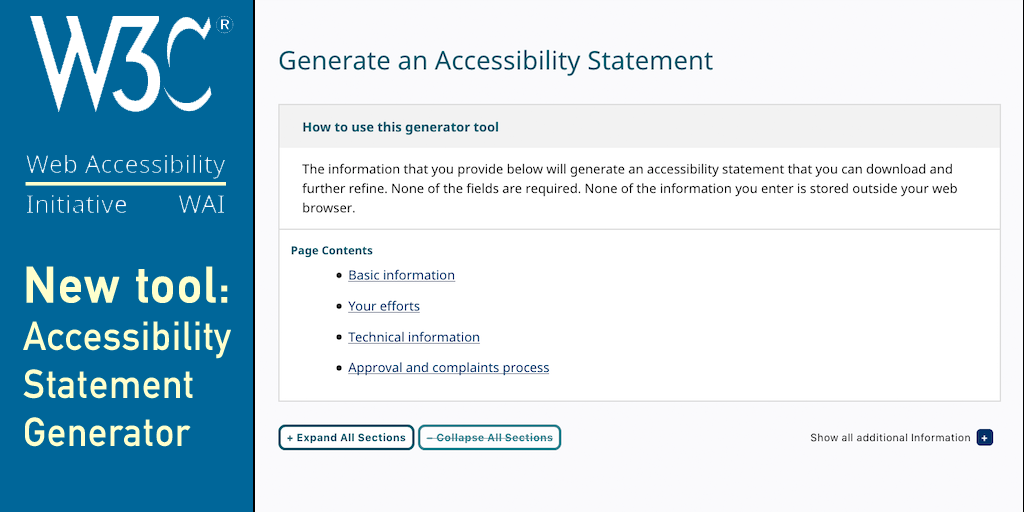
Graphic showing a screenshot of the accessibility statement generator, the W3C and WAI icons and the title of the toolThe WAI Education and Outreach Working Group (EOWG) has published Developing an Accessibility Statement.

The resource helps you create an accessibility statement for your website, mobile app, or other digital content. It includes guidance, examples, and a free generator tool. The tool helps you collect and enter relevant information to create an accessibility statement for your particular content and situation. See more information in How to Create Accessibility Statements blog post.

Learn more about the Web Accessibility Initiative (WAI).


by Xueyuan Jia via W3C News

Wednesday, November 21, 2018

First Public Working Draft: Extensions to the Semantic Sensor Network Ontology

The Spatial Data on the Web Interest Group has published a First Public Working Draft of Extensions to the Semantic Sensor Network Ontology. This specification describes some extensions to the Semantic Sensor Network Ontology, published as a W3C Recommendation in 2017, to enable linking to the ultimate feature-of-interest for an observation, act of sampling, or actuation, and homogeneous collections of observations, in which one or more of the properties may be shared by all members of the collection.


by Xueyuan Jia via W3C News

Thursday, November 15, 2018

First Public Working Draft: CSS Shadow Parts

The CSS Working Group has published a First Public Working Draft of CSS Shadow Parts. This specification defines the ‘::part()’ pseudo-element on shadow hosts, allowing shadow hosts to selectively expose chosen elements from their shadow tree to the outside page for styling purposes.

CSS is a language for describing the rendering of structured documents (such as HTML and XML) on screen, on paper, in speech, etc.


by Xueyuan Jia via W3C News

Friday, November 9, 2018

New Resource: The Business Case for Digital Accessibility

icons: briefcase, shopping cart, gavel, speech bubblesThe WAI Education and Outreach Working Group (EOWG) has published The Business Case for Digital Accessibility. It describes that accessibility can drive innovation, enhance your brand, extend market reach, and minimize legal risk. It includes direct and indirect benefits of accessibility and the risks of not addressing accessibility adequately. It provides case studies and examples that demonstrate how continued investment in accessibility is good for your organization. Learn more about the Web Accessibility Initiative (WAI).


by Coralie Mercier via W3C News

Thursday, November 8, 2018

TTML1 3rd, TTML2, TTML-IMSC1 are W3C Recommendations

The Timed Text Working Group has published the following specifications as W3C Recommendations:

The Timed Text Markup Language is a content type that represents timed text media for the purpose of interchange among authoring systems. TTML Profiles are intended to be used across subtitle and caption delivery applications worldwide, thereby simplifying interoperability, consistent rendering and conversion to other subtitling and captioning formats.


by Xueyuan Jia via W3C News

W3C Invites Implementations of CSS Containment and Flexible Box Layout Module Level 1

The CSS Working Group invites implementations of two updated Candidate Recommendations:

  • CSS Containment Module Level 1 describes the ‘contain’ property, which indicates that the element’s subtree is independent of the rest of the page. This enables heavy optimizations by user agents when used well.
  • CSS Flexible Box Layout Module Level 1 describes a CSS box model optimized for user interface design. In the flex layout model, the children of a flex container can be laid out in any direction, and can “flex” their sizes, either growing to fill unused space or shrinking to avoid overflowing the parent. Both horizontal and vertical alignment of the children can be easily manipulated. Nesting of these boxes (horizontal inside vertical, or vertical inside horizontal) can be used to build layouts in two dimensions.

CSS is a language for describing the rendering of structured documents (such as HTML and XML) on screen, on paper, etc.


by Xueyuan Jia via W3C News

Tuesday, November 6, 2018

First Public Working Draft: Trace Context

The Distributed Tracing Working Group has published a First Public Working Draft of Trace Context. A distributed application is an application that consists of multiple components, also known as micro-services, that are deployed and operated separately. The Trace Context specification defines properties intended for event correlation between micro-services to allow various tracing and diagnostics monitoring products to operate together.


by Xueyuan Jia via W3C News

Selectors Level 3 is a W3C Recommendation

The CSS Working Group has published Selectors Level 3 as a W3C Recommendation. Selectors are patterns that match against elements in a tree, and as such form one of several technologies that can be used to select nodes in an HTML or XML document. Selectors have been optimized for use with HTML and XML, and are designed to be usable in performance-critical code.


by Xueyuan Jia via W3C News