Wednesday, April 24, 2019

New version of the Roadmap of Web Applications on Mobile

Icon representing mobile life-cycleW3C has published a new version of its Roadmap of Web Applications on Mobile, an overview of the various technologies developed in W3C that increase the capabilities of Web applications, and how they apply more specifically to the mobile context.

The April 2019 snapshot introduces a few additional technologies under incubation in the Web Platform Incubator Community Group and refreshes the status of other specifications. See the Change history for details. New exploratory work since the December 2018 snapshot:

A few specifications have also progressed along the standardization track, starting with Web Authentication published as a W3C Recommendation (see Security and Privacy), including Resize Observer (see Device Adaptation) and Feature Policy which have now been adopted by Working Groups (see Security and Privacy), as well as DeviceOrientation Event Specification whose development has now resumed in the Devices and Sensors Working Group (see Sensors and Local Interactions).

Browser support for some of the specifications mentioned in the roadmap has improved since publication of the latest version of the roadmap in December 2018. For instance, Streams shipped in Firefox desktop (see Network and Communications) and Subresource Integrity has now shipped on all main browsers (see Security and Privacy).

Sponsored by Beihang University, this project is part of a set of roadmaps under development in a GitHub repository to document existing standards, highlight ongoing standardization efforts, point out topics under incubation, and discuss technical gaps that may need to be addressed in the future. New versions will be published on a quarterly basis, or as needed depending on progress of key technologies of the Web platform. We encourage the community to review them and raise comments, or suggest new ones, in the repository’s issue tracker.


by François Daoust via W3C News

Tuesday, April 23, 2019

W3C Strategic Highlights, Spring 2019

Pipeline of innovation [Lightbulb design credit: Freepik]W3C released today its W3C Strategic Highlights – Spring 2019, a comprehensive survey of the essential work W3C conducts to achieve a Web for All, and select recent work in many areas where the Web can solve arising problems for real people.

To the pipeline of innovations to enable the Web to scale to meet the new challenges and opportunities, we are making recent additions:

  • W3C chartered a Web Payment Security Interest Group to foster greater coordination and ultimately enhance the security and interoperability of Web payments.
  • Web & Networks: what is needed for the Web to take advantage of 5G, QUIC, and Edge Computing changing the topology of network-based services? We have started to flesh out a group charter in the wake of the W3C Web5G workshop in May 2018.
  • As the Web evolves continuously, some groups are looking for ways for specifications to do so as well. So-called “evergreen recommendations” or “living standards” aim to track continuous development (and maintenance) of features, on a feature-by-feature basis, while getting review and patent commitments.

    Continued progress in many areas demonstrates the vitality of the W3C and the Web community. We see the maturation and further development of an incredible number of new technologies coming to the Web.


by Coralie Mercier via W3C News

First Public Working Draft: CSS Spatial Navigation Level 1

The CSS Working Group has published a First Public Working Draft of CSS Spatial Navigation Level 1. This specification defines a general model for navigating the focus using the arrow keys, as well as related CSS, JavaScript features and Events.

CSS is a language for describing the rendering of structured documents (such as HTML and XML) on screen, on paper, etc.


by Xueyuan Jia via W3C News

Wednesday, April 17, 2019

EMVCo, FIDO Alliance, and W3C Form Interest Group to Enhance Security and Interoperability of Web Payments

The FIDO Alliance, EMVCo, and the World Wide Web Consortium (W3C) announced today the creation of a new Interest Group for organizations to collaborate on a vision for Web payment security and interoperability. Participants in the Web Payment Security Interest Group will define areas of collaboration and identify gaps between existing technical specifications in order to increase compatibility among different technologies.

The Web Payment Security Interest Group charter defines a scope of activities that includes formulation of a vision for web payment security, development of use cases, gap analysis, liaisons with other organizations, and identification of standardization opportunities for each organization. The Interest Group does not publish specifications. Technical work is carried out in other groups within each organization.

You can read more in the joint press release.


by Xueyuan Jia via W3C News

Tuesday, April 16, 2019

W3C Invites Implementations of Accessibility Conformance Testing (ACT) Rules Format 1.0

The Accessibility Guidelines Working Group has published a Candidate Recommendation of Accessibility Conformance Testing (ACT) Rules Format 1.0. It defines a format for writing accessibility test rules. These rules can be evaluated fully-automatically, semi-automatically, and manually. This common format allows any party involved in accessibility testing to document and share their testing procedures in a robust and understandable manner. This enables transparency and harmonization of testing methods, including methods implemented by accessibility test tools.

This draft is now complete and ready for implementation testing. It addresses all comments received on the previous drafts and provides important clarifications on different requirements. Read about the W3C Web Accessibility Initiative (WAI).


by Xueyuan Jia via W3C News

W3C Invites Implementations of Payment Request API

The Web Payments Working Group has published an updated Candidate Recommendation of Payment Request API. This specification standardizes an API to allow merchants (i.e. web sites selling physical or digital goods) to utilize one or more payment methods with minimal integration. User agents (e.g., browsers) facilitate the payment flow between merchant and user.


by Xueyuan Jia via W3C News

First Public Working Draft: Feature Policy

The Web Application Security Working Group has published a First Public Working Draft of Feature Policy. This specification defines a mechanism that allows developers to selectively enable and disable use of various browser features and APIs.


by Xueyuan Jia via W3C News

First Public Working Draft: Strings on the Web: Language and Direction Metadata

The Internationalization Working Group has published a First Public Working Draft of Strings on the Web: Language and Direction Metadata. This document describes the best practices for identifying language and base direction for strings used on the Web.


by Xueyuan Jia via W3C News

Monday, April 8, 2019

W3C honored with a second Technology & Engineering Emmy® Award

NATAS logopictures of the emmy award recipientsLast night in Las Vegas, as the NAB Show was kicked off by the 70th Annual Technology & Engineering Emmy® Awards ceremony, W3C representatives accepted our second Emmy® Award. The prestigious industry award recognizes our work to standardize a Full TV Experience on the Web.

Among the myriad web technologies that the Web Consortium develops, HTML5 has brought videos to the Web, ending the era of plug-ins for media playback. The standards at the core of all web media applications today have turned the Web into an unprecedented media platform, which mixes professional and user-generated content, available anywhere, anytime, on any device, and to anyone.

This marks the second Technology & Engineering Emmy® Award that W3C has received. In 2016 W3C was awarded a Technology & Engineering Emmy® Award for its work on the Timed Text Mark-up Language standard. W3C is grateful for our community and all those who work to build standards and technologies for the web. You can read more in the W3C Blog.


by Coralie Mercier via W3C News

Thursday, April 4, 2019

Pointer Events Level 2 is a W3C Recommendation

The Pointer Events Working Group has published Pointer Events Level 2 as a W3C Recommendation. The features in this specification extend or modify those found in Pointer Events, a W3C Recommendation that describes events and related interfaces for handling hardware agnostic pointer input from devices including a mouse, pen, touchscreen, etc. For compatibility with existing mouse based content, this specification also describes a mapping to fire Mouse Events for other pointer device types. This new W3C Recommendation supersedes Pointer Events Level 1.


by Xueyuan Jia via W3C News

W3C Invites Implementations of WebVTT: The Web Video Text Tracks Format

The Timed Text Working Group has published an updated Candidate Recommendation of WebVTT: The Web Video Text Tracks Format. This specification defines WebVTT, the Web Video Text Tracks format. Its main use is for marking up external text track resources in connection with the HTML <track> element. WebVTT files provide captions or subtitles for video content, and also text video descriptions [MAUR], chapters for content navigation, and more generally any form of metadata that is time-aligned with audio or video content.

This specification is based on the Draft Community Group Report of the Web Media Text Tracks Community Group.


by Xueyuan Jia via W3C News

Thursday, March 28, 2019

W3C Invites Implementations of Verifiable Credentials Data Model 1.0

The Verifiable Claims Working Group invites implementations of Verifiable Credentials Data Model 1.0 Candidate Recommendation. Credentials are a part of our daily lives; driver’s licenses are used to assert that we are capable of operating a motor vehicle, university degrees can be used to assert our level of education, and government-issued passports enable us to travel between countries. This specification provides a mechanism to express these sorts of credentials on the Web in a way that is cryptographically secure, privacy respecting, and machine-verifiable.


by Xueyuan Jia via W3C News

Monday, March 18, 2019

Upcoming: W3C Workshop on Web Games

Illustration showing play everywhere in neon signsW3C announced today a Workshop on Web Games, 27-28 June 2019, in Redmond, WA, USA. The event is hosted by Microsoft.

This workshop aims to bring together browser vendors, game engines developers, games developers, game distributors, and device manufacturers to enrich the Open Web Platform with additional technologies for games, including action, casual, first-person shooter (FPS), multiplayer online battle arena (MOBA), massively multiplayer online role-playing (MMORPG), sports, and Virtual Reality / Augmented Reality (VR/AR) games. Attendance is free for all invited participants and is open to the public, whether or not W3C members.

Expected topics of discussion include:

  • 3D graphics rendering: high-priority features for AAA games, specifications, timeline
  • Multithreading operations: background rendering (OffscreenCanvas), status of SharedArrayBuffer
  • WebAssembly: additional features to make the Web a better build target for game engines, debugging, bindings to new and existing Web APIs defined in Web IDL
  • Cloud gaming: improvements to Web streaming technologies
  • Game input APIs: detection of keys’ physical locations on a game controller, support for advanced controller features, support for game-specific controllers
  • Music/Sound effects in games: improvements to Web Audio and related APIs, mechanisms to use new audio input/output devices, generative music, porting of audio engines to the Web
  • Game assets protection: models, code, game logic, Devtools exploration
  • Game assets management: mechanisms to load and store hundreds of MB of assets in the background, packaging for offline execution
  • Game accessibility and internationalization: APIs, semantics, techniques for rendering, processing, personalization, customization, interoperability, etc. to ensure accessibility of games and address possible internationalization issues

For more information on the workshop, please see the workshop details and submission instructions. Expressions of interest and position statements are due by 10 May 2019.


by Xueyuan Jia via W3C News

Tuesday, March 12, 2019

W3C celebrates the 30th anniversary of the Web

Web 30 logoToday we celebrate the 30th anniversary of the Web and in a few months, we will be celebrating the 25th anniversary of the W3C developing open standards and guidelines that foster innovative applications, profitable commerce, and the free flow of information and ideas.

In March 1989, while at CERN, Sir Tim Berners-Lee wrote “Information Management: A Proposal” outlining the World Wide Web. 30 years ago today, Tim’s memo was about to revolutionize communication around the globe.

Committed to core values of an open Web that promotes innovation, neutrality, and interoperability, W3C and its community are setting the vision and standards for the Web, ensuring the building blocks of the web are open, accessible, secure, international and have been developed via the collaboration of global technical experts.

Today we celebrate a Web that is:

  • Universal, International and truly “World Wide”.
  • Available on any device, for any type of information, in any language.
  • Accessible by people with disabilities.
  • Royalty-free and built on open standards.
  • Powerful – The Open Web Platform makes Web pages themselves powerful tools.
  • Transformational for how business gets done; improving delivery, enhancing user satisfaction, and reducing cost.

You can read more about the celebration and listen to what Sir Tim Berners-Lee said when asked what part of the W3C’s work he’s the most proud in the W3C blog.


by Coralie Mercier via W3C News

Monday, March 11, 2019

W3C Workshop Report: Strong Authentication and Identity

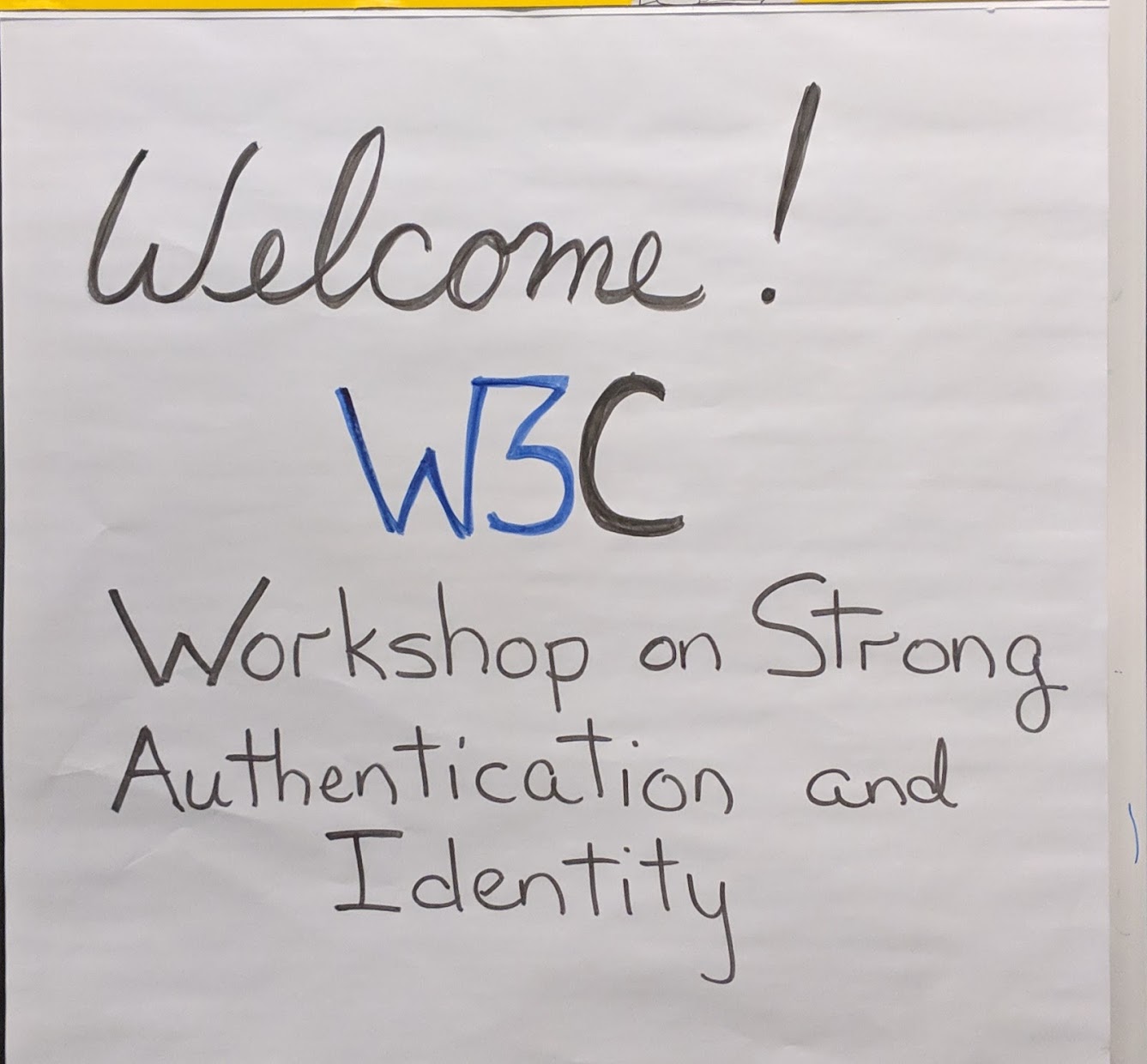
Welcome! W3C Workshop on Strong Authentication and Identity W3C published today the report of the W3C Workshop on Strong Authentication and Identity, held on 10-11 December 2018, in Redmond, WA (USA).

W3C brought community experts together for a series of discussions on strong authentication and identity. We looked at standards work in-progress on Web Authentication and Verifiable Claims, and opportunities for future work including Distributed Identifiers and Attestation. Participants shared motivating use cases that could be aided by web technology, from web application sign-on to supply-chain tracking, government services provision, license authorization, health care, and financial transactions. Presentations and breakout discussions helped to identify gaps and interfaces between work areas, The workshop report describes current state of the art, and offers pointers to new work proposals in and around the W3C community.

W3C thanks Microsoft for hosting, the Program Committee for organizing, and all the participants for their contributions.


by Xueyuan Jia via W3C News

Sunday, March 10, 2019

Authorized Translation of WCAG 2.1 in Simplified Chinese

Screenshot showing the w3c logo and the title of the W3C WCAG 2.1 Web Content Accessibility GuidelinesToday W3C published the Simplified Chinese Authorized Translation of Web Content Accessibility Guidelines (WCAG) 2.1, Web内容无障碍指南 (WCAG) 2.1, contributed by Zhejiang University. The translation is delivered in support of updates to the draft China National Standard on Information technology – Internet content accessibility technical requirements and conformance testing, which refers to WCAG 2.1.

Translations in other languages are listed in WCAG 2 Translations. W3C Web Accessibility Initiative (WAI) particularly encourages the development of Authorized Translations of WCAG 2.1 and other technical specifications to facilitate their adoption and implementation internationally. Read about the Policy for W3C Authorized Translations.


by Xueyuan Jia via W3C News

Wednesday, March 6, 2019

Upcoming: Second W3C Workshop on the Web of Things

Illustration showing a night cityscape and connected pictograms W3C announced today a Second Workshop on on the Web of Things, 3-5 June 2019, in Munich, Germany. The event is hosted by Siemens.

This workshop disseminates the findings of the W3C Web of Things Working Group based on its standardization work and discuss the way forward with a wider set of stakeholders. To unlock the potential of an open ecosystem and open markets, the workshop will discuss how to reduce fragmentation of the IoT landscape and the future direction of the open W3C WoT standardization. A focus is on exposing and consuming services across specific IoT technologies to enable new use cases, such as common monitoring and control of assets from multiple vendors, interconnecting different application domains, and building digital twins of physical devices.

The scope includes:

  • Cross-Domain Business Models, Use Cases and Scenarios:
    • Interoperability scenarios for consumer, industrial, environmental, energy management, healthcare, automotive and smart cities
    • Building a common IoT application ecosystem (tools, marketplaces, security, etc.)
    • Interworking across evolving IoT standards (e.g., OCF, OPC, LWM2M, OneM2M, etc.)
  • Standardization Needs:
    • Architecture
    • Applications
    • Security and privacy

For more information on the workshop, please see details and submission instructions. Expression of Interest and position statements are due by 7 April 2019.


by Coralie Mercier via W3C News

Tuesday, March 5, 2019

First Public Working Draft: User Timing Level 3

The Web Performance Working Group has published a First Public Working Draft of User Timing Level 3. This specification defines an interface to help web developers measure the performance of their applications by giving them access to high precision timestamps.


by Xueyuan Jia via W3C News

Monday, March 4, 2019

Web Authentication: An API for accessing Public Key Credentials Level 1 is a W3C Recommendation

WebAuthn LogoThe Web Authentication Working Group published Web Authentication: An API for accessing Public Key Credentials Level 1 (WebAuthn) as a W3C Recommendation today. This specification defines an API enabling the creation and use of strong, attested, scoped, public key-based credentials by web applications, for the purpose of strongly authenticating users. As a core component of the FIDO Alliance’s FIDO2 set of specifications, WebAuthn is a browser/platform standard for simpler and stronger authentication. It is already supported in Windows 10, Android, and Chrome, Firefox, Edge and Safari Web browsers. Please read more in our Press Release.


by Xueyuan Jia via W3C News

Friday, March 1, 2019

W3C updates its Process Document

W3C Membership approved the 1 March 2019 W3C Process Document, which takes effect today. Notable changes (see all differences) since the 2018 update include:

  • The size of the W3C Advisory Board changes from a fixed 9 to a range of 9 to 11 elected members; election mechanics is adjusted accordingly;
  • Allow one person to represent (with disclosure) multiple organizations in a Working Group;
  • Added new Contributor License Grants to define the requirements for contributions made by non-WG members;
  • Many clarifications and refinements to reduce ambiguities and undefined behavior.

This document was developed between the W3C Advisory Board and the public Revising W3C Process Community Group. Comments and feedback on the new Process Document may be sent as issues in the public GitHub Repository.


by Coralie Mercier via W3C News

Tuesday, February 26, 2019

User Timing Level 2 is a W3C Recommendation

The Web Performance Working Group has published User Timing Level 2 as a W3C Recommendation. This specification defines an interface to help web developers measure the performance of their applications by giving them access to high precision timestamps. User Timing Level 2 is intended to supersede the first version of User Timing specification.


by Xueyuan Jia via W3C News

Thursday, February 21, 2019

Call for Review: Pointer Events Level 2 is a W3C Proposed Recommendation

The Pointer Events Working Group has published a Proposed Recommendation of Pointer Events Level 2. The features in this specification extend or modify those found in Pointer Events, a W3C Recommendation that describes events and related interfaces for handling hardware agnostic pointer input from devices including a mouse, pen, touchscreen, etc. For compatibility with existing mouse based content, this specification also describes a mapping to fire Mouse Events for other pointer device types.

Comments are welcome through 21 March 2019.


by Xueyuan Jia via W3C News

Monday, February 18, 2019

Jun Murai enters the French National Order of the Legion of Honour

Laurent Pic decorating Jun Murai with the Knight of the Legion of Honour Medal. Photo by Susumu ISHITO.We are pleased to announce that Dr. Jun Murai, W3C Steering Committee Member and Professor of Keio University has accepted the Knight of the Legion of Honour Medal from the French government. The decoration ceremony took place on 13 February at the French Ambassador’s residence. The Legion of Honour is the highest French order of merit for military and civil merits created by Napoleon Bonaparte in 1802.

French Ambassador to Japan Laurent Pic, who decorated Murai-sensei, introduced Jun Murai as an “Internet Samurai” in the world. Thanks to Jun’s Internet research activities, his accomplishments contributed greatly to the advancement of society as well as technical progress. In addition, France also showed that he has continued to collaborate with Japan and research exchanges with Japan in the Internet field for many years through him.

Jun Murai speaking after receiving the Knight of the Legion of Honour Medal. Photo by Susumu ISHITO.Following words of thanks, Jun explained in detail the relationship with France in Internet research. “There are a lot of network researchers in the United States but in the part related to standardization, France and Japan combined in many cases, such as the World Wide Web and satellite Internet,” said Jun Murai, before concluding. “I wish this will lead to further development in the digital technology field, including the power of the young people of both countries in the future.”

(Photos by Susumu ISHITO.)


by Coralie Mercier via W3C News

Thursday, February 14, 2019

New W3C Membership level aimed at organizations medium range revenues

Over the past several years the W3C Business Development team has heard from a number of mid-sized companies that while they are very interested in participating in W3C the Membership Fees were too high for them to justify. That was compounded by several conversations members of the W3C Team had with organizations in our newest vertical – Publishing. Many of the drivers in that vertical are in this category and had said a new level would be attractive for them. Based on this, we ran between Feb 2018 and Feb 2019 an experimental Membership level aimed at public organizations that have revenues in the medium range to see if the new level would, in fact, attract Members.

Our goal was to get eight new Members in that time and we’ve reached that goal! The organizations that have joined are Geotab (Automotive), Macmillan Learning (Publishing), Media Do Holdings (Publishing), New Relic, Inc. (Security), The Paciello Group (upgraded!), Ping Identity (Identity), SportTotal (Media) and W. W. Norton (Publishing). As you can see we have a diverse set of industries represented by these organizations and you’ll see them in various groups around W3C. Based on this success we have made this a permanent level and as organizations apply for Membership they will see this option.

This Membership Fee is available for existing Members as well if they qualify (it is designed for public organizations that have revenues between $50M and $500M USD, or equivalent in the other currencies of W3C Hosts). If you are interested in this, or have any questions or comments please contact J. Alan Bird, W3C Global Business Development Leader.


by Coralie Mercier via W3C News

W3C Invites Implementations of CSS Transforms Module Level 1

The CSS Working Group invites implementations of CSS Transforms Module Level 1 Candidate Recommendation. CSS transforms allows elements styled with CSS to be transformed in two-dimensional space. This specification is the convergence of the CSS 2D Transforms and SVG transforms specifications.

CSS is a language for describing the rendering of structured documents (such as HTML and XML) on screen, on paper, etc.


by Xueyuan Jia via W3C News

Thursday, February 7, 2019

Solidarity of the W3C to the family of Vagner Diniz

The W3C Team and Offices offer their sincerest condolences to our W3C Brazil Office Manager Vagner Diniz, his wife and family, for the tragedy that befell them when the Brumadinho dam collapsed late January, claiming the lives of their daughter Camila, their son Luiz, their pregnant daughter-in-law Fernanda and other family members whose bodies we keep hoping they find. We have no words in the face of such a dramatic and horrifying event and our hearts go to them as well as the many people who, directly and indirectly, have been hit.

Since 2001, years before the 2007 launch of the W3C Brazil Office, hosted by the NIC.br (Brazilian Network Information Center) institute, in São Paulo, many in the W3C Team and global W3C Community have known and have met Vagner at different occasions. Our heartfelt condolences to Vagner Diniz, his wife Helena Taliberti, and his entire family.


by Coralie Mercier via W3C News

Tuesday, February 5, 2019

First Public Working Draft: WebXR Device API

'AR Headsets (Magic Leap, Hololens, etc.) could replace phones, TVs and screens' (Feb. 2017) The Immersive Web Working Group has published a First Public Working Draft of the WebXR Device API. This specification describes support for accessing virtual reality (VR) and augmented reality (AR) devices, including sensors and head-mounted displays, on the Web.

Hardware that enables Virtual Reality (VR) and Augmented Reality (AR) applications are now broadly available to consumers, offering an immersive computing platform with both new opportunities and challenges. The ability to interact directly with immersive hardware is critical to ensuring that the web is well equipped to operate as a first-class citizen in this environment.

Immersive computing introduces strict requirements for high-precision, low-latency communication in order to deliver an acceptable experience. It also brings unique security concerns for a platform like the web. The WebXR Device API provides the interfaces necessary to enable developers to build compelling, comfortable, and safe immersive applications on the web across a wide variety of hardware formfactors.


by Coralie Mercier via W3C News

Monday, February 4, 2019

Working Group Note: Character Model for the World Wide Web: String Matching

The Internationalization Working Group has published a new Working Group Note: Character Model for the World Wide Web: String Matching which provides authors of specifications, software developers, and content developers a common reference on string identity matching on the World Wide Web and thereby increase interoperability.

String identity matching is the process by which a specification or implementation defines whether two string values are the same or different from one another. It describes the ways in which texts that are semantically equivalent can be encoded differently and the impact this has on matching operations important to formal languages. Topics include normalization and case folding.


by Coralie Mercier via W3C News

Thursday, January 31, 2019

W3C Invites Implementations of CSS Values and Units Module Level 3; CSS Scroll Snap Module Level 1

The CSS Working Group invites implementations of two Candidate Recommendations published today:

CSS is a language for describing the rendering of structured documents (such as HTML and XML) on screen, on paper, in speech, etc.


by Coralie Mercier via W3C News

Thursday, January 17, 2019

Call for Review: Web Authentication: An API for accessing Public Key Credentials Level 1 is a W3C Proposed Recommendation

The Web Authentication Working Group has published a Proposed Recommendation of Web Authentication: An API for accessing Public Key Credentials Level 1. This specification defines an API enabling the creation and use of strong, attested, scoped, public key-based credentials by web applications, for the purpose of strongly authenticating users. Conceptually, one or more public key credentials, each scoped to a given WebAuthn Relying Party, are created by and bound to authenticators as requested by the web application. The user agent mediates access to authenticators and their public key credentials in order to preserve user privacy. Authenticators are responsible for ensuring that no operation is performed without user consent. Authenticators provide cryptographic proof of their properties to Relying Parties via attestation. This specification also describes the functional model for WebAuthn conformant authenticators, including their signature and attestation functionality.

Comments are welcome through 14 February 2019.


by Xueyuan Jia via W3C News

Thursday, January 10, 2019

Call for Review: User Timing Level 2 is a W3C Proposed Recommendation

The Web Performance Working Group has published a Proposed Recommendation of User Timing Level 2. This specification defines an interface to help web developers measure the performance of their applications by giving them access to high precision timestamps.

Comments are welcome through 7 February 2019.


by Xueyuan Jia via W3C News

Tuesday, January 8, 2019

W3C Advisory Committee Elects Technical Architecture Group

W3C TAG logoThe W3C Advisory Committee has elected the following people to the W3C Technical Architecture Group (TAG): Alice Boxhall (Google), Sangwhan Moon (Odd Concepts) and Theresa O’Connor (Apple). They join co-Chair Tim Berners-Lee and continuing participants, Daniel Appelquist (Samsung Electronics; co-Chair), David Baron (Mozilla Foundation), Hadley Beeman (W3C Invited Expert), Kenneth Rohde Christiansen (Intel Corporation), Peter Linss (W3C Invited Expert; co-Chair), and Lukasz Olejnik (W3C Invited Expert). Yves Lafon continues as staff contact. Many thanks to Travis Leithead (Microsoft) and Alex Russell (Google), whose terms end at the end of this month.

The mission of the TAG is to build consensus around principles of Web architecture and to interpret and clarify these principles when necessary, to resolve issues involving general Web architecture brought to the TAG, and to help coordinate cross-technology architecture developments inside and outside W3C. The elected Members of the TAG participate as individual contributors and not representatives of their organizations. TAG participants use their best judgment to find the best solutions for the Web, not just for any particular network, technology, vendor, or user. Learn more about the TAG.


by Xueyuan Jia via W3C News

Monday, January 7, 2019

New version of the Roadmap of Web Applications on Mobile

icon representing mobile life-cycleW3C has published a new version of its Roadmap of Web Applications on Mobile, an overview of the various technologies developed in W3C that increase the capabilities of Web applications, and how they apply more specifically to the mobile context.

The contents of the roadmap have been updated to follow the evolution of the Web platform since July 2018. See the Change history for details. This new version highlights exploratory work recently started in the Web Platform Incubator Community Group (WICG) to close the gap with native:

Browser support for some of the specifications mentioned in the roadmap has improved since publication of the latest version of the roadmap in July 2018. For instance, Media Queries Level 4, described in Device Adaptation is now supported by all main browsers. Picture-in-Picture is now also supported in Firefox mobile, and has experimental support in Safari (see Media).

Sponsored by Beihang University, this project is part of a set of roadmaps under development in a GitHub repository to document existing standards, highlight ongoing standardization efforts, point out topics under incubation, and discuss technical gaps that may need to be addressed in the future. New versions will be published on a quarterly basis, or as needed depending on progress of key technologies of the Web platform. We encourage the community to review them and raise comments, or suggest new ones, in the repository’s issue tracker.


by Xueyuan Jia via W3C News